Posts

Third International Receptive Ecumenism Conference

Image
Receptive Ecumenism is one of the new movements within the ecumenical scene but hardly a new phenomena. When I was 19 I was invited to be part of a World Council of Churches discussion group in Bristol on the theme of 'Giving account of the hope that is in us'. The experience of hearing what other Christians understood by hope started a process of seeing how I could incorporate into my spirituality the insights of others that I experienced as being of value. Many others have had similar experiences and it is that fact that has been taken up in recent years and turned into a project. That project has been largely led by Durham University and the work of Professor Paul Murray. It has been adopted with some enthusiasm by the Roman Catholic Church as well as other ecumenical partners. The project in Durham has had three specific areas of focus including, for example, looking at what different traditions in the North East of England have done in the area of leadership and wh...

Commemorating World War 1

Image
The following is the text (slightly adapted) of a paper I gave at the meeting of the URC's Peace Fellowship in October. I have placed it in the ecumenical blog simply because there are ecumenical questions and implications for what we decide to do.   "The concern I have developed regarding the forthcoming commemoration of the start of World War 1 was triggered by a letter from the government to faith communities inviting them to be involved. The letter specifically referred to a proposed event on August 4th in Westminster Abbey but of course by extension invited faith communities to be involved with the whole period of commemoration. This was placed on the agenda of the Free Churches Group meeting in April 2013 just after the letter was received.   Government initiatives have developed since then but the focus remains on encouraging as many parts of society as possible to join in the commemoration, including making it possible for school children to visit the battl...

Post Assembly reflections

Image
Perhaps the first question one asks oneself at a gathering such as the World Council Assembly is, 'What can I compare it with?' and the second is 'What use is it?'.   One inevitably garners the answer to the first question from one's own experience and my answer is therefore that it feels like a cross between a URC General Assembly, or perhaps a Methodist Conference and the German Kirchentag. The answer to the second question can only really be found after some deeper reflection on the experience as a whole.   There were numerous strands to the event which lasted from October 29th to November 8th and drew in the region of 5,000 people in the Bexco conference Centre in Busan, South Korea. Not all were official delegates and in fact they were in the minority. Many others came as observers, delegated representatives from non-member churches or because of their engagement with one or other of the themes that made up the wider agenda of the assembly. Some...

And outside there were protests.....

Image
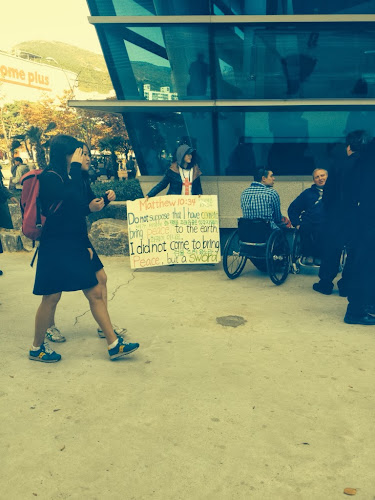
We knew before we came that there were going to be people protesting against the WCC outside the Assembly. These protests started even before the day began with quite a large scale gathering which was heavily policed and even resulted in a hoax bomb call that brought in the local SWAT team. The protests have continued right throught the Assembly with one man sitting outside the halls with a large placard in English indicating that he has been fasting and praying against the heresy of the WCC for the whole period of the gathering. On day 12 he was looking decidedly thin and drawn. I took one of their leaflets on the first day and found it contained a mix of political opposition and conservative theology that used the langauge of serving satan, communism, heresy and the need for repentance. A car has been circling the assembly halls for several days with loudspeakers through which the driver has endlessly announced that 'Jesus is coming now, repent!'. It's easy ...

Watching the process of amending WCC statements

Image
In the last business sessions the fine tuning of the wording of the statements and messages from the Assembly provides a fascinating insight into the complexities of the interaction, not just of language but of theological emphasis, contextual concerns, ethical stances and so on. The paragraphs of the statements are projected on screen and worked on one by one with contributions from delegates on phrasing, grammar and sometimes on deeper issues of emphasis. Especially when a statement is about, for example, the search for peace in the Middle East the contributions can become quite emotional and the desire to be even handed can conflict with the desire for a statement to be strong in favour of positive action on behalf of suffering groups. Similarly, the statements that are more concerned with theology can produce contributions that remind one of the argument over whether the Holy Spirit proceeds from the Father and with the Son... or proceeds from the Father and the Son and w...

Justice and Peace

Image
The themes of Justice and Peace have been at the heart of what the Assembly is about. As I write this, the business plenary is negotiating the wording of a statement asking for the theme to be integrated into the future direction and programme of the World Council by means of a shared pilgrimage of Justice and Peace. The theme of evangelism too has incorporated the perception that issues of Justice and Peace cannot be separated from the ultimate goal towards we which we believe God is moving not only the Church but the whole of creation, that we cannot evangelise without including these themes in the message we share. As a balance, the idea that Justice and Peace can somehow be detached from spirituality and the communication of the Good News is also addressed and corrected. My own sense has been of a gradual growth of a holistic perception of what the mission of the Church is. For me this is all about the expansion of our spirituality, moving away from narrow interpretations to ...

A General Reflection on the Assembly

Image
Every now and again I find myself thinking about the assembly in general rather than about aspecific part or theme. After a while I began to wonder what I could compare it with and the best I can say is that it like a cross between the URC General Assembly (or indeed Methodist Conference, General synod etc:) and the German Kirchentag. I realise that isn't particularly helpful for anyone not familiar with the Kircentag in particular but it reflects two dimensions. One is the level of debate and decison making, setting agendas and diplomacy, the other is the level of the meeting, listening to one another and sharing of experiences. Un any ways iy is the second level that gives the greatest value to the experience. There could, after all, be other ways of making decisions but there is no substitte for bringing together people from every continent to share together in a huge spiritual melting pot. The challenge to those of us who are experiencing this and to the churches bac...